

Photo by Mary Anne McDonald
Emma Dupree
Fountain’s Herbalist & Healer
My friend and colleague Karen Baldwin knew Emma Williams Dupree better than I. Much of Karen’s life’s work in eastern North Carolina is archived in the Karen Baldwin Folklore Collection at ECU. She produced the first academic documentation on Emma and was instrumental in getting her presented the Brown-Hudson Award from the North Carolina Folklore Society in 1984. Dupree also received the North Carolina Heritage Award in 1992.
Decades before such terms as eco therapy, holistic healing, and nature therapy were in vogue, Emma Dupree championed the healing properties of plants using their roots, stems, and flowers and celebrating in her way daily what became nationally known, in 1969, as Earth Day.
Living in Fountain, I’ve collected details and anecdotes on her life and enjoyed trying to keep her name and legacy alive, primarily through the Emma Dupree Day that was first held at Fountain Presbyterian Church in 2017. I created the Wikipedia entry on Dupree, using mostly Karen Baldwin’s article, published in Folk Arts and Folklife in and around Pitt County: A Handbook and Resource Guide by the Folklore Archives at East Carolina University in 1990, and I presented a talk on her at the ECU med school’s Laupus Library that you can watch–by far the best part is near the end, when several of Emma’s family and a few who knew her speak in descriptive detail about her. The Herbal Academy has an excellent entry on her, using a few more of the beautiful photos taken by Mary Anne McDonald, who also received the Brown-Hudson Award, in 2003, for preserving, researching, and disseminating North Carolina’s folk culture.

Emma Dupree’s headstone, St. John’s Missionary Baptist Church, Falkland, NC. RAFoto.
I’m no physician nor folklorist, except by avocation. Others, such as Jim Kirkland and Holly Matthews at ECU have done the field work to help place Emma Dupree’s life and work into larger contexts. But the best source is the terrific documentary made by Dr. Walter Shepherd and ECU medical students in 1978, Little Medicine Thing. Much of it is spent following Mrs. Dupree around her yard in Fountain, three blocks from where I live today, as she explains to students what she’s pulling from the ground. Watch it.
Emma Dupree was born on July 4, 1897 in Falkland, where she spent the first third of her life, before moving to Fountain. She died March 12, 1996 and is buried at St. John’s Missionary Baptist Church on NC 222 in Falkland.
Just a block west from what was once Emma Dupree’s personal herb garden in her Fountain yard, at the corner of Jefferson and Mills Streets, we dedicated, on April 16, 2022, a historical marker commemorating her renown, which is also celebrated annually during Fountain’s Emma Dupree Day, on April’s first Saturday.
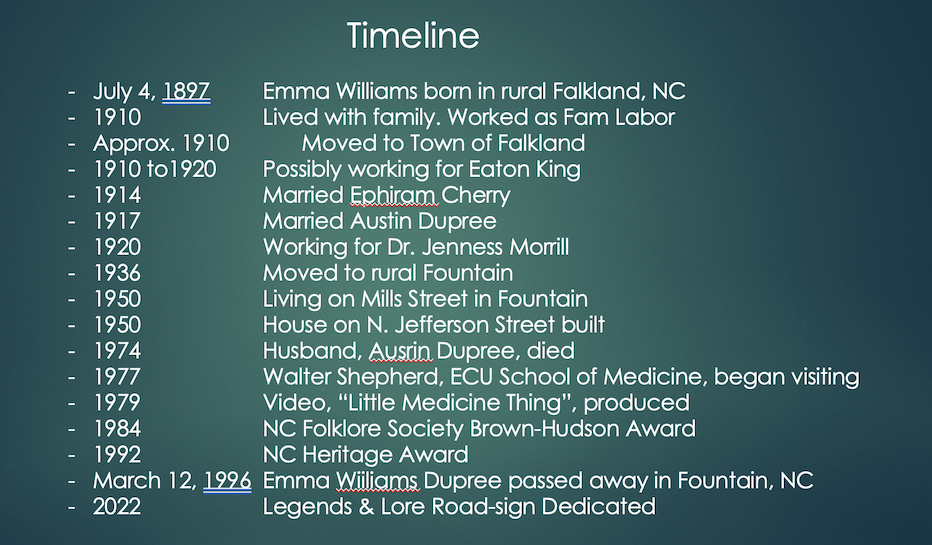
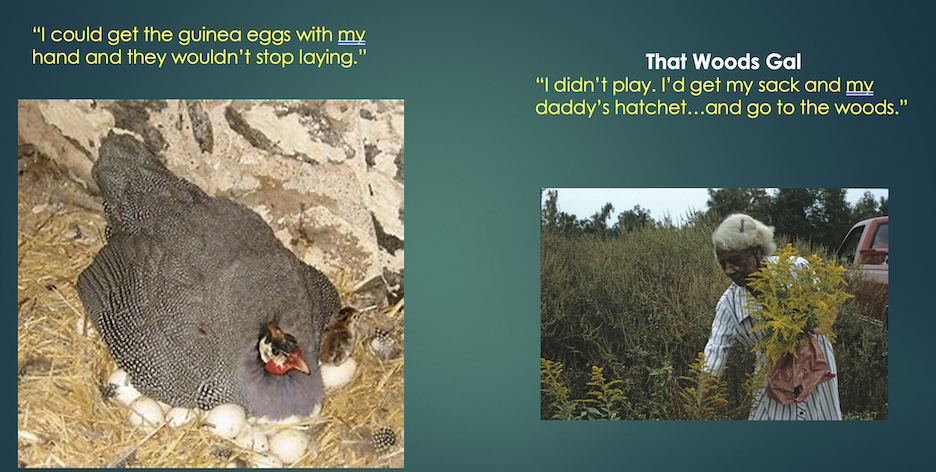
For Emma Dupree Day this year, Walter Shepherd presented a power-point update on his continuing research into Emma’s life. He added excellent details about her working relationship with a Falkland physician, prior to her moving to Fountain, and through careful U.S. Census research, he also clarified and filled in several important dates in her life. Walter continues with his research, and he has graciously allowed the use here of highlights from his presentation. The slides below are the basis of his presentation; I’ve added some local details to text.
• • •
The Life and Times of Mrs. Emma Dupree
by Walter L. Shepherd
April 12, 2025 • Emma Dupree Day
Fountain

Fountain is at the western edge of North Carolina’s Inner Banks, swampy in lots of places and with a high water table. Falkland, a river town, was once a port vital to commerce between Tarboro and Greenville and on to Washington and the Pamlico Sound, what Stan Riggs calls “North Carolina’s ‘other ocean.'” Fountain grew up as railroads were replacing rivers as primary commerce routes in the early 20th century; Falkland’s importance faded as Fountain began to thrive. But its days, too, were numbered. Emma would have witnessed the glory years and the fading ones of both towns.

Emma’s parents were sharecroppers, a hard life but common in the rural, agrarian South, where in many places it operated as a system more akin to slavery than to free market enterprise. The quality of life for the sharecropper, like that of the enslaved, was determined by the one who owned the land. For Emma’s family, it was Dupree farm.

By 1900, according the census, Noah was a “day laborer” and Puss, a “farm laborer.”

It’s not clear when the road from Falkland to Fountain was paved. Rivers were easier to travel on, of course, but direction-limited. One of my favorite local river stories was told by Jim Ellis, the gentleman farmer/preacher/lawyer and local (oral) historian, who recalled his school being let out when a boat tooted, alerting his teacher/principal that he had to rush to the Tar to raise a bridge. So to remain “supervised,” the kids went along.

Not many people can keep the three F-towns of Pitt County straight until they’ve lived in one of them. This map will help. Walter has indicated the farm where Emma grew up, off Dupree Road and above Dupree Crossroads. and near Otter Creek where it joins the Tar River. When the East Carolina Railway was being built from Tarboro to Farmville, Fountain became a big commercial hub, its streets filled on Saturdays with shoppers who rode in to town on the Yellowhammer.

Courtesy of Veronica Newton

Emma’s dad was named Noah Williams–he must have had a strong sense of his daughter’s gifts. The Seven Springs hotel and resort operated from 1881 to 1944 to accommodate those who came to the springs.

 Dr. Jenness Morrill lived in this beautiful house in downtown Falkland. He was born in Pitt County on April 2, 1865, to Dr. Samuel and Sarah Elizabeth Virgen Morrill, who had moved from New Hampshire to Farmville about 1850. Jenness Morrill earned his medical degree from the University of Maryland in 1888 and began practicing in Farmville, first with his father, and then in Falkland, where he was the town physician until shortly before his death in 1939.
 Walter makes the reasonable assertion that Emma would have learned considerably from her work with Dr. Morrill, preparing medicines and treatments. Several others have noted similarities between her remedies and those suggested by Native Americans, making it easy to see how Emma’s treatments were derived from blending three cultures through the prism of her natural gifts.


• • •
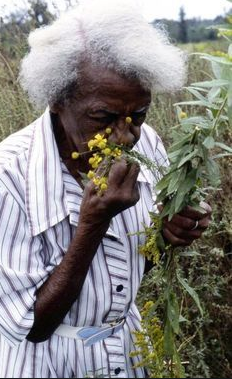
Photo by Mary Anne McDonald.
a partial list of herbs used by Emma Dupree:
sage
double tansy
rabbit tobacco
sweet flag [wetland]
pokeweed
jimson weed
white mint
mullein
maypop [passion flower]
catnip
horseradish
sassafras
silkweed
“healing berry tree”
–Alex Albright
ugust 28, 2025
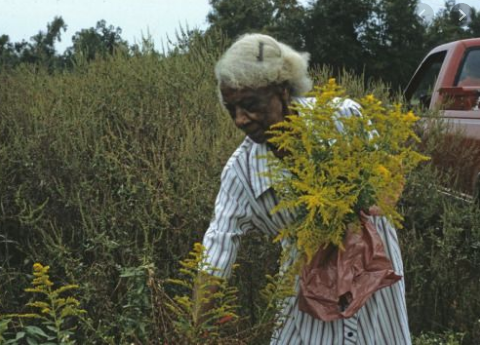
Photo by Mary Anne McDonald.
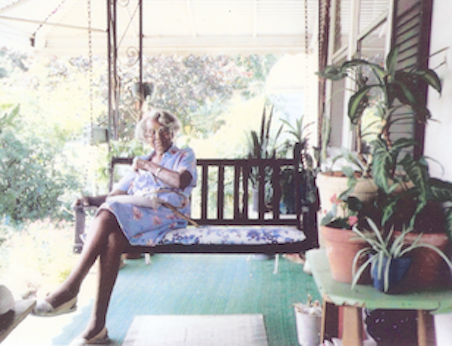
Aunt Emma at home in Fountain. Courtesy of Veronica Newton.
The outdoors photos above by Mary Anne McDonald were taken for NC Folklife/ NC Arts; Aunt Emma on her porch was loaned to me by her niece, Veronica Newton, who wasn’t sure of the photographer’s identity.