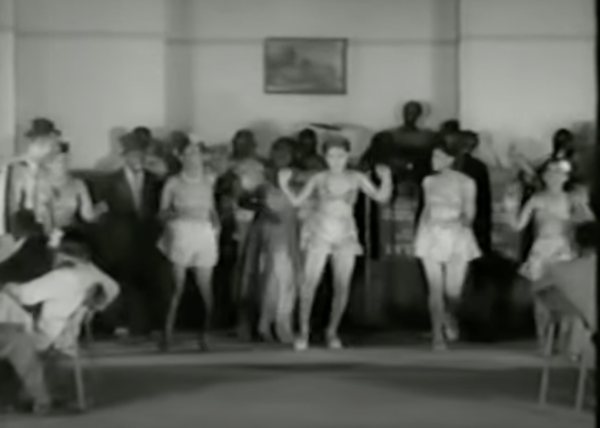
-this page is under constructions-
 Generalizing a typical Winstead’s Mighty Minstrels’ show is difficult, and over the years it’s made moreso by how the routes, performers, and performance schedules changed. During much of the 1930s, its golden age, typical routes found them playing 1-week or sometimes longer stands in a small town in.a harvest region, set up in the same tent at the sane lot, year after year. A week’s schedule:
Monday – parade at noon to announce the show’s arrival into town–showtime 7:30 that evening. Show would be straightforward vaudeville, with a moderator such as J.C. Davis, comedians and a skit, a chorus routine, a blues singer, some novelty acts–a mentalist or contortionist, a trick bicyclist, sometimes a “human oddity” such as Chief Ironhand andAlice the Alligator Girl picked up from a circus sideshow.
Tuesday – all in, a full-stage extravaganza, with lots of prizes given out. Star acts would get more prominence in the bill.
Wednesday – St. Louis blues night featuring the ladies with accompanists and the band.
Thursday – Amateur night, from which sometimes a performer would be recruited.
Friday – Double show, with a Midnight Ramble afterwards. At the evening show, one feature was often a mass wedding, played for laughs, in which all the preformers who were already married, or staying together, got married together on stage.
Saturday – Regular show, though sometimes two on a Saturday with another ramble afterwards.
But other times, they’d be skipping from town to town, night to night, just like most of their competition.
Winstead’s was essentially tented vaudeville with a good house band, which would be featured the throughout the evening, in feature pieces, as accompanists to vocalists, background music for specialty acts., and bridges between acts. The best musicians were excellent readers as well as improvisers, expected to lead the parade and work steady all night; the most prized also could perform a specialty on stage. ST&D performers were the most valuable to a show: they could sing, talk (be funny), and dance.

Mattie Sloan at home in Laurinburg, with Peanut, 1987. Photo by Alex Albright
Much depended on where they were. A parade audience might be mixed, but a show would generally be segregated, Blacks on one side of a rope down the middle, or in some places, sectioning off a portion of the back area. Some towns would only allow segregated showings. “But we played mostly Black audiences,” said Mattie Sloan, Winstead’s long-time road manager whose husband, Frank, was also its band leader.
By the Depression, traveling tented vaudeville was hardly the top of the entertainment chain. But those working for Winstead and shows like his kept their performers in cash and accommodations for as long as they could stay on the road, attracting a mix of performers who’d been on the road for decades with hopefuls like Dewey “Pigmeat Markham,” the Durham comedian whom Mattie Sloan said worked Blackface comedy with Winstead’s until he saved enough money to go to New York. “We put our tent up in the parking lot of a Catholic church in Greensboro,” she said, “and the priest took up some money for him, too, and he left for New York the next day.” Markham said in his 1969 memoir: “Can you believe this?” I didn’t do a show out of blackface until 1943!”
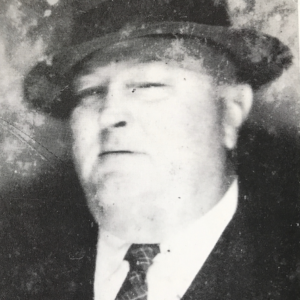
Emerson Stowe “Fat” Winstead, Sr. Mattie Sloan Collection of Black Minstrel Ephemera. Special Collections, ECU, Greenville, NC.
Who performed with Winstead was sometimes impacted by who became available as a season progressed. The actors interchanged with other shows; they married or partnered up for a season or part of one, or their partner did; they settled down, sometimes able to get a job in music but usually not.
“We had some of the best actors in the world,” Mattie Sloan told me, proudly. “But we also carried some of the worst in the world. See, Fat would pick up some of these people couldn’t do nothing, and he’d carry them, find ’em a job putting up signs or selling tickets. Claude Dixon.” She paused at the memory and shook her head. “He was supposed to be a comedian, but he was pitiful. Pitiful. He’d tell his jokes and nobody would laugh and the he’d go sit in the audience and wouldn’t laugh. He might’ve been good once, but he’d gone down. We buried him in Raleigh.”
Winstead’s shows had a mixed reputation: they seemed, on one hand, a kind of traveling vice carnival, but they were also patterned in almost every way, including cast and routing, after Silas Green from New Orleans. One report says the Winsteads, Fat and his wife, Helen, “are more like parents than an employer.” How many shows Winstead operated is not clear, and he took advantage of the fact that an indeterminate number of them used “Georgia” in their titles. Mattie Sloan said that he used varying names for his shows to deflect trouble: When confronted with an allegation, he could say that wasn’t our Georgia Minstrels–that was another group. I’ve found references to his operating Winstead’s Mighty Minstrels, the Georgia Minstrels, the Shufflin’ Sam Company, Broadway Rastus, and the Florida Blossoms. and he may have been a partner in Backer’s Georgia Minstrels. Some shows were on the road at the same time.

Winstead’s Mighty Minstrels advertising paper. Detail. Mattie Sloan Collection of Black Minstrel Ephemera, Special Collections, ECU, Greenville, NC.
Actors & Singers
Arnte, Diamond Tooth Bill. Fortune teller, singer.
Arnte also had his own traveling show that was sometimes attached to a circus or carnival. Mattie Sloan said:
He told fortunes. He had diamonds in both sides of his mouth. His mouth sparkled. Women folks’d have a fit. He’d have lights flashing in the room, sparkling on his teeth. He went overseas to see the King and Queen. He had this act where he’d put a lamp on his head and tell your fortune. He did magic works. Surles [who owned the show after Winstead died] said everything he told him came true. He could sing and dance. He sang the blues, too. Had a comic song he sang. He just came out in show business to find his way out of telling fortunes. I wouldn’t let him tell mine. He had lots of money, but one woman broke him, and then some guys beat him, took the diamonds out of his mouth, I mean right out of his mouth, messed him up bad, and he wasn’t the same after that. He was a fine man, though.
Boykins, Arthur, actor, 1933, straigh, wencht & character 1936
He was from Philadelphia, Mattie Sloan said, and married Pula from Georgia: “She was on the radio there. He played a womna’s part with Pot Liquor. We called him Buttermilk. He disd this old maid act, him and Pot Liquor. It was an Aunt Jemimah act. His dress was black with white dots and with white ruffles. He had a broom. He’d act like he was going to throw the broom in the crowd. He was a good actor, very sensitive, easy to be insulted. Took up with Pula in /richlands, Georgia–that and Cuthbuert were the roughest towns.”
Boykin, Lucille. cast 1936
Bowens, Pearl. cast 1943 [dancer w/ Mattie?]
or Goings?
Burrell, Rosa. Singer, fire-dancer.
Mattie Sloan said she claimed to have been with the Brown Skin Models but doubted it: “She’d never been on no show. She was with us one night. Doing that fire act [as she performs in “Pitch a Boogie Woogie”], getting down on her knees, she fell down–she was drunk. She stayed in Kinston, maybe Wilson, but she wouldn’t say where her home town was. Her husband was with Silas Green. We left her in Kinston.”
Bryant Sisters. Feature 1943.
[Butterbeans & Susie]. Comedian impersonators.
Mattie Sloan said that this couple were the only Whites that worked Winstead’s, but their Blackface routine did not fool or please their Black audiences; they worked for 3 nights. THey were crooks, she said, who stole cars and robbed restaurants: “He got killed in prison–she’s in Philly with her parents.”
Cabbage. Comedian.
Played role of wench in comedy sketches.
Chief Iron Hand. Trick bicyclist, fire eater 1936.
Cornell, Billy. Comedian 1939.
Davis, James C. Producer, manager, emcee. 1933, 1934, 1935, 1936.
Davis sang soprano in a quartet with Silas Green from New Orleans in 1924 and a comedian with them in 1925. In 1927, still with Silas Green, he was the “tenor singing banjoist”; with the Florida Blossoms in 1931, he was simply the “singing banjoist.” The Chicago Defender reported on the ’31 show that: “J.C. Davis is producer and has one of the fastest shows ever on the road,” with a cast of 21 plus a 12-piece orchestra in which he also played brass. They traveled in 12 “specially built trucks.” His wife, Mrs. Vennie Davis, was in the chorus line and remained with him during his Winstead years.
Davis, Vennie. Chorus, actor. 1933, 1933, 1935, 1936
Dennis, Bessie. Chorus director 1943
Dixon, Claude. Comedian.
Dixon, Maizel. ca. 1936.
Dupree, Lillie Mae. Prima donna, 1935.
Earl, W.M. [William] feature 1941, 1947.
William Earl was another old-timer whose career was extended by several years work on Black vaudeville shows such as Winstead’s, the Florida Blossoms, and Irvin C. Miller’s Brown Skin Models. Willie Jones thought him among the best comedians of all time, “good as Bert Williams,” he told me. His brief appearance as an eccentric dancer in the Grand Finale of “Pitch a Boogie Woogie” is the only image I’ve seen of him.
Green, Joe & wife. trick bicyclists, 1936.
Gresham, Kike. comedian, 1935
Foster, Chick. Stage 1933, straight & character, 1936.
Frazer, Joe. Illusionist & feature, 1941.
Gillens, George. Stage, 1936.
Gillens, Bobbie. Stage, 1936.
Glover, Sophie. Chorus dancer.
Mattie Sloan said Glover was from New Orleans and that “she had a different man every night. Next morning, she’d go put all her clothes in the trash and buy her a new set.”
Grant Sisters. Acrobatic singers, dancers, 1943.
Green, Joe & wife. Trick bicyclists, 1936.
Ham. Comedian.
Mattie Sloan said he was from Chicago: “‘Have mercy!’ he’d say and they would scream. He’d do the ‘Mess Around’ with his arms out, turn the place out,”
Harris, Dee & Louise, dancers, 1935.
Dee. Stage 1933
Louise. Cast 1936.
Hot Popper. Comedian.
Mattie Sloan said Hot Popper was from Savannah, Georgia and that he worked at a filling station there during off season: “I don’t know what ever happened to him. He had his wife and two daughters and a boy with him. The baby girl did contortionist, the older one danced on stage with the chorus girls. His wife died suddenly. One girl’s still with a carny, I heard, and the other’s got two or three children. But he was funny. Could make you laugh right off the stage.”
Johnson, Catherine. Chorus dancer, lead, 1947.
“Catherine was a carny,” Mattie Sloan said. “That was working in the side show, and that’s where she came from, on the side show. She wasn’t on the minstrel show.. She came with Bob Young, then she left and came over to our show again with Johnson, a trombone player. I been trying to locate him because they say he still lives. She was a very good chorus girl, beautiful, worked hard. but they all drink, each and every one of ’em drinks. She was a very good chorus girl. She just died last year in Fayetteville.”
Johnson, Daisy & Johnny. Dancers, 1933.
Mattie Sloan said this young sibling dance team was joined the show after they performed at an amateur night at what she called a “slave camp” outside Cuthbert, Georgia. Prosecution for running such peonage camps, as they were called in the 20th century, was rare. She said Winstead’s played this particular camp annually: “They had a schoolhouse, a church, and two stores inside the [barbed wire] fence, and they had the guards with shotguns all around. They let us set up outside the fence and guards surrounded the tent during the show.”
Of the Johnsons, she said: “They were good. So Fat gave the man a thousand dollars to buy ’em out. He looks at Fat and looks at the money and says ‘You want ’em all?’ Fat says, ‘Just get them dancers and send ’em up to Columbus [Georgia].'” The kids danced with Winstead’s for several months and then disappeared. “I found out later,” Sloan said, “they’d gone back to buy their mama out.”
Jones, Slim. Comedian, 1938.
Jones, Theresa. Chorus, 1935, 1936.
Mattie Sloan said that she was from Texas, a chorus dancer who also had a specialty as a fan dancer: “She got killed by her old man in her own bed, but boy could she dance. Her husband and her come off the carnival in the winter. She took 666 all the time. I’d buy it by the box and sell bottles to people on the show. Her husband, he played trombone, he’d take a teasponful and they’d get stoned. She was with the show a year, then she went to a carny, and then she came back and stayed a little while. I don’t remember her husband’s name but we called him Blabbermouth. He was a good looking man and a fine trombonist and then she took up with Buster [Price] for a while. She cooked for him, kept it clean. Then one day he left. She wouldn’t go. But then she took up with the school principal out of Georgia, Murphy I think. He’d lost his school. Every time she met a new man, she’d take him. She was a beautiful lady.”
Jones, Sparkle. Stage, 1935.
Jones, T.H. Stage , 1936.
Jones, Virginia. Cast, 1943; blues singer & correspondent, 1935; blues singer, 1936.
According to Mattie Sloan, Virginia and her husband, Willie Jones, were together for 23 years. “He was a young one,” she said. “She called him her son, said she raised him. All them girls got young men like that, and they trained ’em. They had a comedy act together too, where they’d sing ‘A Good Man is Hard to Find’ and turn the words around.” From Wilson, she sang with the show off and on for most of its duration. After she retired, she became a freelance cook in Fayetteville. “Willie gambled all her money away, though,” Sloan said, “and he got to where he would’t put the cork on so Winstead had to fire him. He ran off to Georgia with this young girl–she made him go to work on a trash truck. Three months later he was dead. Virginia stepped in front of a car trying to kill herself. Finally died back home in Wilson. She could sing, though. It’d tear you up to hear her singing ‘You Going to Need Me.’ She was better that Bessie [Smith], I always thought.”
Jones, Willie. Virginia Jones’ spouse. Dancer, comedian, 1936, 1943. Stage manager 1936. [Not the same as Willie “Ash Can” Jones, a dancer and comedian who worked with Irvin C. Miller’s shows for several years and appears, uncredited, in “Pitch a Boogie Woogie.”]
The Jones’ were noted in press accounts as a duo with Winstead’s cast in 1936.
Jones, Yvetta. Stage, 1933.
Kemp, Viola. Chorus, contortionist.
In early 1947, she starred in Sammy Dyer’s show at Club DeLisa in Chicago, where she also performed with Red Saiunders. She had joined Winstead’s in time to be in Greenville in July ’47 for filming of “Pitch a Boogie Woogie.” In 1944 she worked as a contortionist with the Jimmy Lunceford band
Keith, Frank. Comedian, 1935.
Leach, Elizabeth. Stage, 1933.
Louis, Joe. Boxer, specialty appearance.
Mattie Sloan said, “We gave Joe Louis $500 flat one night just to walk across the stage wearing his gloves.” Louis had post cards that she sold for him, “but he never came back the next day to collect the rest of those post cards,” so they continued to sell them as they traveled. “We were a ten cent show, and we were selling post cards of Joe for a quarter. We must have had a thousand of them, and they never came back to collect the money.” Or the rest of the cards, two of which are in the Mattie Sloan Collection at ECT. She later clarified that the $500 was for a week’s engagement in Fayetteville that he didn’t complete.
Lockhart, Carter. Comedian 1939.
Lumpkins, Lamar. Comedian.
According to Mattie Sloan, he died while the show was in Laurinburg.
Margie, aka “My doll.”
Winstead’s did not regularly carry acts that would also have gotten work as human oddities on circuses. Margie, 19, was 20 inches tall and weighed 24 pounds. Mattie Sloan said, “She was with us for about three weeks, her and her mother. Her mother was tiny, too. I made both of ’em’s picture.”
Markham, Dewey “Pigmeat.” Comedian.
Markham was born in the Hayti section of Durham in 1904. Mattie Sloan said: “Pigmeat Markham played with us but Mr. Winstead wouldn’t hire him–didn’tlike his attitude. He wanted to be the big star. He worked with us till he got the money to go to New York. Him and a White man had a team. We sent them to New York the last of ’32. We did a show on the parking lot of the Catholic Church in Greensboro and the priest kept Pigmeat at his house that night and he went to New York the next day.” [The timing of this anecdote fits with a scenario that has Markham, like many vaudevillians, falling on hard times at the beginning of the Depression, years that are not covered in his memoir, Here Come the Judge, which does demonstrate an intimate working knowledge of the Florida Blossoms Minstrels, from his work with them in the 1920s; by the early ’30s, Winstead appears to have gained control of the Blossoms. I’ve also come to believe that it’s necessary to add a couple of years to most dates that Mattie Sloan includes in her narratives.}]
Mick, Mickey & Shine, tap dancers.
Mattie Sloan said, “Mr. Winstead got them some green suits and white shoes. They went through too many women, though.”
Montgomery, Louise. Chorus, 1933, 1935.
Mullins, Daisy. Stage 1933.
Nelson, Daybreak. (1895 – ) Comedian.
Nelson was well-known as a comedian and show manager during the 1920s working primarily in Black vaudeville.
In September 1922, he and his “chirper Miss [Ossie] McPherson” were part of a 7-act bill at the Standard Theater in Philadelphia, where they “scored a decided hit.” Her “A Man Gets Tired of One Woman all the Time” was a whang and brought a brace of encores Encore No. 1 she sang the feminine version which brought a regular April shower from the ladies present.”
By March 1923, he and Ossie were starring in Joseph Jones’ Syncopated Syncopators. Nelson “did the heavy comedy and drew many laughs while his partner Ossie McPherson who has established a reputation in Indianapolis responded to many encores.” A Chicago Defender reviewer wrote:
This aggregation is one of the best I have ever seen on the T.O.B.A. “Daybreak” Nelson is a very funny comic and his work is an outstanding feature. Besides being funny he can act– the show is great. . . .
Must not fail to mention the pretty drops and costumes that add to the beauty of the little show, and I hope the TOBA circuit will soon boast of more shows of the caliber of Joseph Jones’ Syncopated Syncopators. jones “a supreme artist, handles the straight leads and as press and public has proclaimed him, is one of our foremost straight and character artists. His delivery his perfect, his personality great, and his dress as up to date as of yore. . . However I would rather see him in drama. Nevertheless, his work in his own show cannot be excelled or improved upon.
Wesley Varnell, a regular reviewer for Billboard, enjoyed the show in April at the Star Theater, Shreveport, Louisiana. Although he was disappointed that it “numbered only eight people,” it “registered a good ninety per cent and pleased the full house that turned out in spite of the opposition presented by Raymond Hitchcock at the Grand Theater and the Al. G. Barnes Circus at the fair grounds.” Varnell also thought the show handicapped because two of its stars, Chance Oakley and Lemer Brooks, had “closed without notie at Hot Springs to join a carnival company,” and were replaced by Mickey Ferguson and Ellen Burton. He adds: “McPherson and Neson placed some S.D &T, stuff that got the three bows and called for an encore.”
In 1924, Daybreak and Company became Daybreak Nelson’s Pepper Steppers, starring Daybreak and McPherson and they began a long residency in Dallas and Fort Worth, Texas, before resuming work on the T.O.B.A. circuit.
Their return engagement, in a 5-scene, 2-act show at the Vendome Theater in Hot Springs, Arkansas, got a “great reception.” The cast included Vera Woodard, blues singer, and Bessie Williams, ballad singer, the show “a real performance in every respect. Every girl works in the chorus and reds lines.” Daybreak “mopped up with ‘Then Put on Your Silver Slipper,’ ‘Home Sick Blues’ and a broken-foot dance which put the show on ice for some time.”
By the early 1930s, he is for the most part off the road, at leisure in Detroit and Baltimore, before joining Winstead’s for another season of comedy. Mattie Sloan believe that the second elderly dancer in “Pitch,” with William Earl, is Daybreak Nelson. She said he performed on Winstead’s several years; in 1954, his pay in June was usually in the $6/ day range but by September it was down to $3.50-$4/ day, and on September 29, Mattie Sloan noted in her book that he was “out.”
She didn’t think much of his act: “He was supposed to be a comedian,’ she told me,” but he won’t no good. He come off a carney–all them men come off a carney won’t no good. He stayed with Snookum [Russell]’s mother in Durham. It was hot one night, and we’d rolled the curtains up, he came up and started talking to us–fell in love with Josie right there. He had hickory striped pants, a gray hat, and blue coat on, wore them a long time. Real dark skinned. Came from an aristocratic family in Winston Salem. We left him in Newport News. ”
Nelson, Mary. Cast 1936.
O’Neill, Shakey. stage 1933, comedian 1936
Niece, Walter. Stage, 1936.
O’Neill, Rose. Stage 1933; Chorus 1935, 1936.
O’Neill [O’neal, Oneal], Shakey. aka Pot Likker. Comedian. 1935.
Mattie Sloan said the O’Neills joined as a husband-wife duo. “He was short,” she said, “and had a great big stomach. If you saw him do the Mess Around, you’d die. He’d turn the show out, shaking his behind. I showed all the chorus girls how to do the shimmy, and Pot Likker could do it better than any of the girls. He picked up dances real quick.”
Randolph & Mary. Tap dancers.
Mattie Sloan said they were a husband & wife team from Chicago, and that “she had beautiful dimples.”
Ray, David. Dancer.
Of Dancer, Mattie Sloan said he was “a fine dancer. he died in Philadelphia, fell dead in the streets. He didn’t know who his mama was but he found her and then he died.
Realms, Dorothy. Stage, 1933.
Roberts, John. Stage, 1935.
Robinson, Noah. Stage 1933, featured comedian 1935, 1936.
Sarah. Chorus dancer.
Mattie Sloan said she was a Catholic from Fayetteville: “She was a chorus girl and sold tickets some, too. She smoked them aspirin cigarettes. Joined a carney later. She married on the show in Danville, Virginia, to Brown, a trumpet player with us. He dropped dead getting off a subway.”
Shavers, Alice. Cast, 1936
Simms, Eva. Chorus, 1935.
Sloan, Mattie. Dancer.
Mattie Sloan occasionally filled in as a dancer on a show, usually in a specialty. I asked her what dances she did, and she lists some of the immediately and others as our talk goes on: Susie Q, shimmy, walking the dog, the breakaway–“that was a one step”–throw it in the creek.
Smith, Bessie. Blues singer 1937 [with Winstead’s and two other shows he owned, Backer’s Georgia Minstrels and what was formerly Irvin C. Miller’s Broadway Rastus. The Baltimore Afro-American supports Mattie Sloan’s assertion that Smith was working for Winstead when she was fatally injured in an automobile accident in Mississippi: “The night before [the accident] she had performed with Winstead Minstrel at Darling, Mississippi en route to Memphis.” Willie Jones also said that Winstead had gotten the title to Irvin C. Miller’s Broadway Rastus show during the 1930s.
Smith, Mae. Stage, 1935.
Weinberger, David. Emcee.
Wiggins, Ford. Comedian, 1935
Wiles, David. Comedian. Producer 1938.
Williams, Essie Mae. Stage, 1933.
Williams, Johnny. Stage, 1933.
Willie. Canvas boy.
Mattie Sloan said he was from Florida:
He fell asleep on Mr. Winstead’s coat after a poker game one night and he came back hours later, when he discovered it missing, and woke him up. When Willie saw all the money he’d been sleeping on, he started crying. “Why would’t God wake me up?” Winstead just laughed at him, said he was lucky. Willie drowned in the Delaware River. It was awful. The bus choked down on a bridge, and he was on front of it trying to get it fixed, trying to keep it primed. The bus hit the rail of the bridge and it threw him over. We got out and saw him floating down the river. They found his body and we buried him in the next town we came to. He’d gotten in trouble in Florida and had to get out. Mr. Winstead sent his mother some money.
Wright, Mrs. Lilly. Stage 1933
Young, Bob.
Young’s role with the show wasn’t clear. “Bob Young wasn’t a showman, Mattie Sloan said “Bob Young wasn’t a showman,” Mattie Sloa “He was a gentleman.” Hhe traveled with the show and made some photos, and his wife, Edith was a chorus girl. They worked Myrtle Beach in the summers, where he made a living playing 3 card molly: “That’s the bean trick but uou call it that so nobody knew you were doing the bean trick.” It’s an “act” that would likely have fit in with Winstead’s carnival-like atmosphere.
Zeke, aka “Little Bit.” Comedian
• • •
Ever-more ephermal: First Name or Nick-name only
A cast comprised entirely from Mattie Sloan’s memory; all descriptives are from interviews with her.
Ellen, from the Eastern Shore.
We got her in Sanford, from Kelly’s show [Kelly’s Colored 40]. She played drums, sang, too, sang “I Cover the Wter Front.” Her boyfriend, named Shorty, played trumpet.
Leon. Singer.
[Talk of Pigmeat Markham reminds Mattie of Leon] Hayti, yes. We got a good boy from there, named Leon, sang “Look Down that Lonesome Road before You Travel There.”
Randolph & Mary, tap dancers from Chicago
She had beautiful dimples.
Some I heard only by name, dropped by Mattie Sloan as she talked: Po Boy, Kent & Flossie, and
Some by a descriptive phrase that often encapsulated someone’s life: Hamburger, who wasn’t on the show: “He got killed on a bridge there on 301 y that motel man, Horn,” Mattie Sloan said. “He sold liquor for Surles with his wife, Horn got off for it, never did no tie, but I think it cost him.”
Slim & Boy Boy, canvas boys who were staying in Winstead’s storage barn when it burned up with, among much else, all of Mattie Sloan’s possessions.
Red: Never wore shoes, got arrested one time for not wwearing shoes. He was on the show but he never wore shoes. They arrested him in Lumberton, put him in jail cause he wouldn’t wear shoes. People just diddn’t trust him.”
Sources
Abbott, Lynn and Doug Seroff. Ragged but Right
Abbott, Lynn and Doug Seroff.. Out of Sight
Hayes, Bob. “Here and There.” Chicago Defender 18 Feb. 1938: 19.
Jackson, J.A. “J.A. Jackson’s Page: In the Interest of the Colored Actor, Actress and Musician of America.” Billboard. 29 Jan. 1921:
Long, Hi Tom. “Reviews, Hot Springs, Ark.” Billboard 25 Oct. 1924: 49.
Markham, Pigmeat. Here Come the Judge! New York: Popular Library, 1969.
“7000 attend funeral of Bessie Smith.” Baltimore Afro American 9 Oct. 1937: 1, 2.
Sloan, Mattie Barber. Telephone interview. Laurinburg, NC. 23 Aug. 1986. add other dates
Sloan, Mattie. Winstead’s Salary book, ms. 1954. Mattie Sloan Collection of Black Minstrel Ephemera, Special Collections, Joyner Library, ECU, Greenville, NC.
Varnell, Wesley. “Varnell’s Review, Star Theater, Shreveport, La., April 9, Evening performance.” Billboard 28 Apr. 1923: [photocopy does not include page]
–21 July 2025